The US Supreme Court could today set in motion the process of striking down Section 5 of the Voting Rights Act of 1965.
This rules that jurisdictions with a history of racial discrimination need to get permission from the federal government before enacting changes to voting procedures. It was a historic victory for the civil rights movement.
However, Shelby County, Alabama claim that Congress exceeded its constitutional authority when it reauthorised Section 5, which was only ever supposed to be temporary.
It also claims that such restrictions are not necessary because black voter registration and turnout rates now are high and that black elected officials are commonplace.
However, if the Act is overturned, expect the politics of election law to become more, not less furious.
The UK is having its first elections for Police and Crime Commissioners (PCCs) tomorrow, (Thursday 15th November). Citizens will have the chance to elect an official who will have the powers to:
appoint and dismiss chief constables
set out a five-year police and crime plan
determine local policing priorities
Teresa May has claimed that they will 'be a voice for local people'. Perhaps, perhaps not. However, there is a real concern that their democratic role will be undermined by low turnout. So what could have been done?
Ways increase turnout - lessons from academic research
Low turnout is a problem because elected Commissioners may not be representative of broader public opinion. It also reduces the legitimacy of Commissioners and perhaps their effectiveness too.
In some senses, low turnout would not be a surprise because voter turnout is generally lower in 'second order' and 'third order' elections. Citizens vote in elections that they consider to be more important, such as general elections. Turnout would probably have been low, whatever.
However, based on established academic research government could have done much more to avoid low turnout. It could have:
Hold the election at the weekend, not a Thursday. Why?
Some democracies hold elections at weekends and research suggests that this helps turnout.
Better still, allow voting over several days. Why?
As the US election showed, many US states allow voting weeks in advance. Why not allow voting to take place over several days? Research shows how this can improve turnout.
Provide more information about candidates. Why?
As I said before, research shows that providing free-post leaflets to candidates helps boost turnout. The government decided against this and instead set up a website. This is problematic because a significant amount of the UK still doesn't have internet access. A telephone line for the public has been set up, but it has received criticisms.
Hold the elections in May. Why?
November is a bad time for electoral officials who are busy updating the electoral register. This means that they their resources are drained and they cannot invest in public awareness activities, as they might at other points in the year. I interviewed many electoral administrators and they were concerned about a November election.
More importantly, research shows that combining elections can help boost turnout. If elections were combined with local or other elections in May, turnout might have been much higher. Ideally, combine it with a general election.
There have been some claims that November's 'early and dark nights' reduce turnout, I'm not aware of any research that demonstrates this. But please correct me if I'm wrong.
Plan better.
Research shows that errors made in the way that elections are run, voters' interactions with poll workers etc., can undermine confidence. The Electoral Commission issued some early warnings that planning had not progressed sufficiently at the earlier stages. There are some reports of leaflets not being delivered on time, problems with the telephone helpful for voters and confusion about who can and cannot be a candidate. Some teething problems are inevitable, but they might have been avoided, and won't help turnout and public trust.
Electing Commissioners on the Cheap
The bottom line seems to be that the election could have been improved if more was spent on running it. Understandably, the government will be keen to keep costs down. Primarily, they will be concerned about arguments from the Labour Party that the money spent on the election could have been spent on more police officers.
However, if we are to have PCCs then it is important that they are not elected on the cheap. It undermines the eventual Commissioners, it undermines the police, and it undermines democracy
Earlier in the summer, there was some speculation that Tony Blair may yet dramatically return as Prime Minister.
When asked by the Evening Standard whether he would want another term he said 'sure'.
Some British Prime Ministers have returned to office after leaving power. These include Lord Palmerston, Benjamin Disraeli, William Gladstone, Lord Salisbury, Stanley Baldwin, Winston Churchill and Harold Wilson. Most recent leaders, as Kevin Theakston notes, tend to end up doing a variety of other things.
But was Tony Blair any good the first time around?
This is obviously a very controversial question. For some he will be remembered as a 'war monger' because of his decision to invade Iraq; for others an apologist for Thatcherism, for dropping many of Labour's left wing policies; for others the successful moderniser of the Labour party who presided over a successive years of economic prosperity and growth in Britain, and whose achievements also included peace in Northern Ireland.
There has been very little explicit scholarly work which has sort to evaluate Prime Ministerial performance. This stands in great contrast to the the US where assessing American Presidents has span many pages.
Dr. Jim Buller (University of York) and I have just published a new article on how political scientists should assess British Prime Ministers. Our method provides a framework for assessing whether they are successful at winning office and maintaining a sense of governing competence, particularly on the key issue of the economy.
The article considers the case of Tony Blair and argues that he was very successful at this. His party won three full parliamentary terms in a row, a feat not achieved by any other Labour leadership clique. Moreover, it significantly altered the methods by which the party fought elections, reforms that remain in place to this day.
Similar points might be made about the criterion of governing competence. Not only did Blair and his colleagues re-establish Labour's reputation in this area, but some of the policy changes put in place to fulfil this objective (particularly Bank of England independence) now have a lasting legacy.
Although Blair failed to devise a consistent and compelling narrative for New Labour, which had a significant impact on the climate of British politics, the party did win the political argument on important issues, such as greater expenditure on public services.
Party management was arguably Blair's least strong suit in the sense that he was unable to prevent the splits between leader and rank and file that had plagued his successors. But overall, Blair's leadership deserves a very high place in any future league table of British prime ministers.
It has to be said that a Blair return is some way off. Ed Miliband has built up a lead in the polls and the questions about his leadership have retreated. If he loses the next general election then he may not survive as party leader and we should expect a leadership contest, but there will be plenty of younger leadership candidates in the frame if that happens. Unfortunately for Blair one poll has suggested that Labour support would drop (except in the South-East) if he was to become leader again.
So was Tony Blair a great Prime Minister? Here are some of his most famous moments, to help you decide.
Barack Obama has been re-elected as President of the United States. Thankfully, there is a winner with a significant margin meaning that there is not a repeat of 2000. Twelve years ago the result was decided by the US Supreme Court after the controversy over 'hanging chads' and 'butterfly ballots' in Florida.
However, had the election been tighter, would this have been the case?
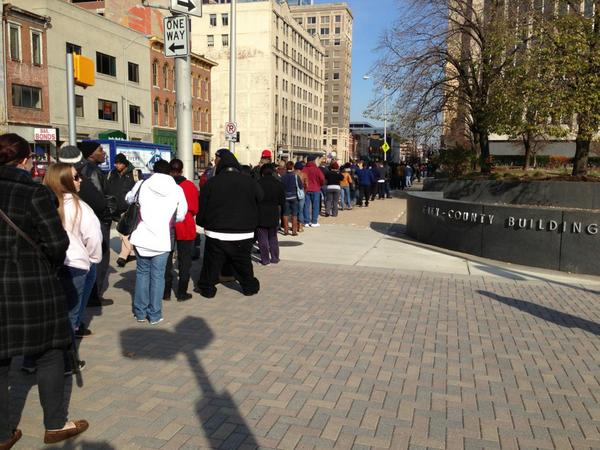
What is clear is that problems remain with the administration of elections in the US. Across the country, lengthy queues formed at polling stations. An election official from the Marion County Election Board, Indianapolis, Indiana tweeted a picture (below) demonstrating the length of queues forming at one polling station. Did voters patiently wait or vote, or did the queue deter them? '[W]e did lose a few who didn't want to wait', admitted the election official.
Elsewhere, there was widespread confusion in Philadelphia. Republicans had sought to introduce a voter ID law but a judge ruled that implementation should wait until after the Presidential election. Widespread confusion ensued among voters and poll staff. Was ID required or not (in fact, it was needed only for first time voters)? There were reports that some poll workers and 'election observers' were deliberately asking for voter ID, even though it was not required. One tweeter (below) posted a picture of these signs that they found and took down.
The US, often held up as a pillar of democracy, has a darker side to its elections. Often these problems are a result of deliberate strategies of vote suppression. Politicians and their agents perceive that they can gain electoral advantage from discouraging their opponents’ supporters to vote. Voter ID laws have been shown to be particularly 'effective' at reducing turnout among certain populations. They are also a useful method for threatening voters at polling stations.
Another tactic is deliberately under-funding election boards. The Marion County Election Board, referred to above, complained that they wanted more poll sites, but 'Republicans had vetoed our resolution for more at each election since 2010' (sic). In Florida 2000, it was areas dominated by Democrat voters that saw the greatest queues form - areas which suffered from under-funding. Republican politicians held the purse-strings.
Problems are not always caused deliberately. They can stem from failures of electoral management. Poor planning on behalf of electoral officials and a lack of training can lead to problems for the voters. Some polling stations, including some in Ohio, ran out of ballot papers. In Miami-Dade County, host to the problems in 2000, scanning machines broke down leaving voters to queue for hours. Further problems will problem emerge over the coming weeks.
There is an urgent need to understand how failures of electoral management can be avoided (or reduced). They are not the reserve of newly democratising countries or electoral autocracies such as Russia. They also take place in the US, and, as scenes from the 2010 general election demonstrated, the UK. The UK Electoral Commission has developed some strategies for improving election administration which my research has suggested has had some positive effects. However, academics and policy makers should work together to find ways to improve elections. Efforts to suppress legitimate voters require rigorous scrutiny from the media and public.
Thankfully, the 2012 election appears to have been decided by the voters, not the administration of votes. But things could have been very different.
The UK Cabinet Office published a report last week on the attitudes of under-represented groups towards electoral registration and individual registration.
It was written by the consumer marketing company NFK-NOP.
Legislation to change the way that UK citizens register to vote is working its way through Parliament. Registration rates have been falling dramatically in the UK.
Some of the findings from their qualitative interviews do chime with some of the academic literature on electoral registration/voter participation (including my research on the experiences of electoral administrations). Notably:
Many citizens who are interested in politics don't register because they lack the information or 'triggers' to do so (p.7-8)
Some decline in electoral registration may occur amongst those who are currently registered by other people (p.12).
There are concerns about use of national insurance numbers because of the prospects of identity fraud (p.13).
There is support for the idea of allowing registration when accessing other government services (p.13).
Young people suggest smartphone apps should be available (p.13-4)
Overall, a strong theme is the need for information campaigns.
This is a useful study, but there is still a need for further academic and policy research on electoral registration in Britain. Information campaigns can only go so far and there is a need to make registration simple and to open multiple channels for voter registration.
Online voter registration was in the news last week.
In the US state of Washington citizens will be able to register to vote via Facebook. This will use a piece of software developed specially by Facebook and Microsoft.
The development of online registration is especially important in Britain. Here, the government's legislation to introduce individual electoral registration (IER) will have its second reading in the House of Lords on Tuesday. My research on the effects of IER (a copy is also available on my website) found that we should expected IER to reduce electoral registration rates. We therefore need other ways to increase registration rates in Britain to offset this decline.
The UK government has always been in favour of online registration and it published the eagerly awaited implementation plan for IER last week included.
Online registration is a good thing though, yes? I've said so before. The logic is that by opening up as many methods of registering to vote as possible, registration rates will rise. Citizens are increasingly online and government services need to adapt accordingly.
However, there might be a catch. Faced with budget cuts electoral administrators may use online registration as a replacement for other methods. This seems to be Harrow's thinking. They have introduced it partly as a way of saving money. Fortunately, they appear to be keeping the 'old fashioned' paper registration mechanisms too.
This line of thinking informed the government's decision to not pay for campaign literature for candidates for the UK's Police and Crime Commissioner elections. Instead, of paying for one free leaflet per candidate, there would be one website on which citizens could find out about who was standing, and what for. This was quickly criticised for reinforcing digital divides and reducing electoral participation.
There is also this recent research paper by Elizabeth A. Bennion (Indiana University) and David W. Nickerson (University of Notre-Dame) which suggests that online registration can make citizens less likely to register. Citizens need regular reminders, they claim, in order to re-register online.
The devil is therefore in the detail. Citizen's experience of online registration therefore needs further research and its implementation in Washington, the UK and everywhere else should be carefully monitored.
In the 2010 general election, the electoral system was said to have heavily advantaged the Labour party. Sounds unfair? Perhaps. This very useful video explains why.